
Car Keys, Key Fobs & Replacement: What You Need to Know

Updated: Aug 23
Car keys have changed considerably over the years. What used to be a simple piece of cut metal may now contain a transponder chip, remote-control electronics, proximity technology, or a combination of all three.
When a car key is lost, damaged, or simply stops working, replacing it is not always as simple as making another copy. The correct solution depends on the vehicle, the type of key, and the electronic security system used by the manufacturer.
At B-SAFE Lock & Key in Minneapolis, we help Twin Cities drivers with automotive keys, car key replacement, key cutting, transponder keys, key fobs, and programming for many makes and models.
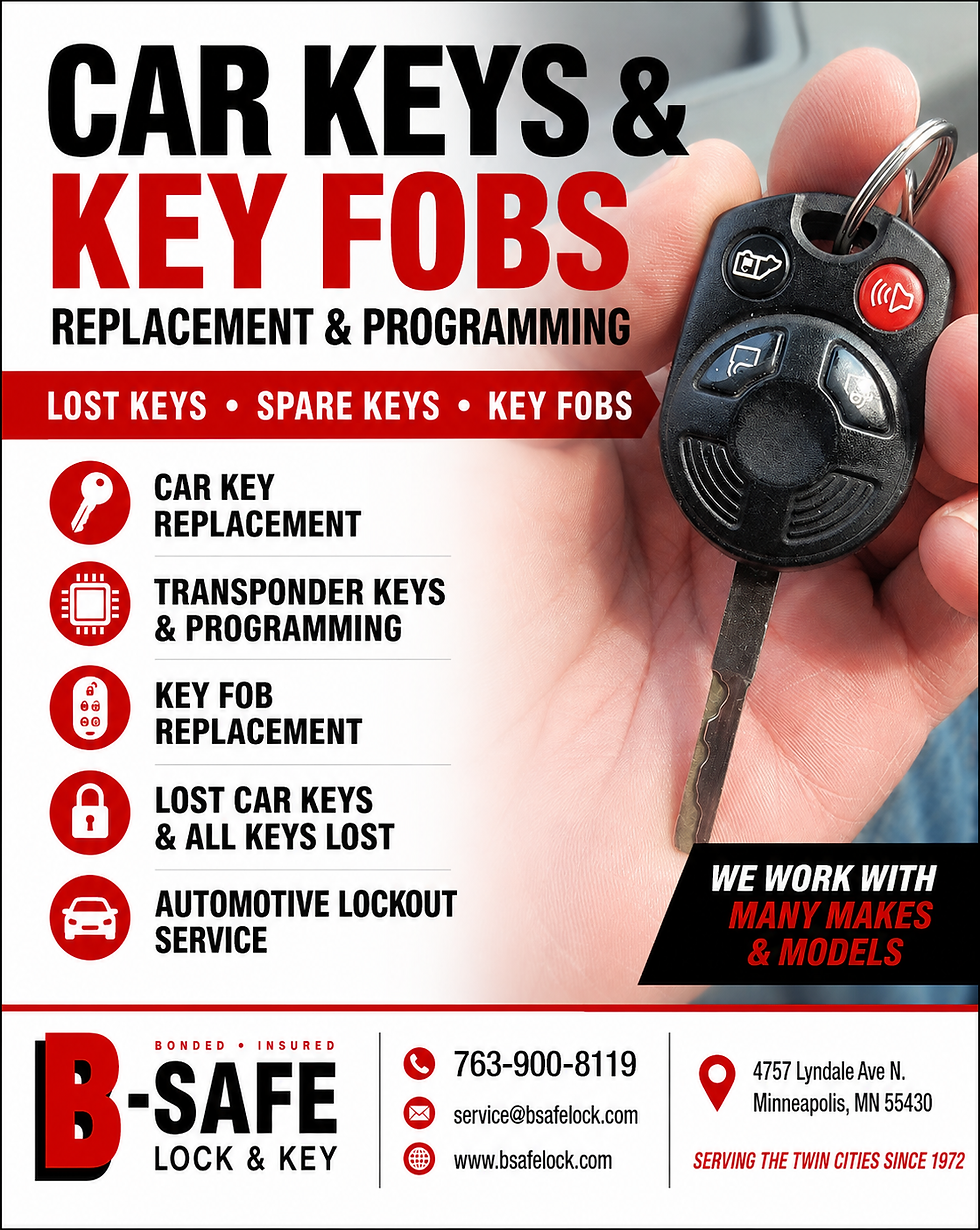
Automotive Keys Are No Longer Just Metal
Older vehicles commonly used traditional mechanical keys. As long as the cuts matched the vehicle's door and ignition locks, a properly cut key could operate the vehicle.
Modern vehicles are different.
Many automotive keys now contain a transponder chip that communicates with the vehicle's immobilizer system. A key can be mechanically cut correctly and still fail to start the vehicle if the proper transponder is not present or programmed correctly.
Other vehicles use remote-head keys, flip keys, key fobs, smart keys, and proximity keys. These can combine several functions into one device, including locking and unlocking doors, trunk or liftgate release, panic functions, remote entry, and engine authorization.
That is why modern car key replacement frequently involves both mechanical key cutting and electronic programming.
Common Types of Car Keys
Traditional Metal Keys
Traditional automotive keys contain no electronic transponder or remote. They are mechanically cut to operate the vehicle's locks and ignition.
These keys are still found on older cars, trucks, vans, and some commercial vehicles.
Wear is important. After years of use, the cuts on a key can become rounded or worn. Whenever possible, making a replacement from accurate key information or a properly decoded key can be preferable to simply duplicating a badly worn original.
Transponder Chip Keys
A transponder key, commonly called a chip key, contains a small electronic transponder that communicates with the vehicle's immobilizer system.
The transponder itself is typically passive and does not depend on the key-fob battery for power. The vehicle energizes and reads the transponder when authentication is required.
If the mechanical cuts are correct but the transponder is missing, incorrect, or improperly programmed, the vehicle may not start.
This is why replacing many modern automotive keys requires two separate operations:
Cut the key correctly.Program the transponder correctly.
B-SAFE Lock & Key provides automotive key cutting and programming services for many vehicles throughout Minneapolis and the Twin Cities.
Remote-Head Keys and Flip Keys
A remote-head key combines the mechanical key blade, transponder, and remote-control buttons into a single unit.
Flip keys operate similarly, except the mechanical blade folds into the remote housing and extends when needed.
These keys can suffer from several different problems. The blade can wear, buttons can deteriorate, the case can crack, batteries can weaken, or internal electronics can become damaged.
Sometimes the entire key does not need replacement. A damaged housing or worn button assembly may be repairable while the existing electronics remain usable.
Key Fobs
A key fob generally refers to the electronic remote used to communicate with the vehicle. Depending upon the vehicle, it may control door locks, the trunk or liftgate, panic functions, and other features.
Some key fobs work alongside a separate mechanical or transponder key. Others are incorporated into a remote-head key or smart-key system.
A failed key fob does not automatically mean the entire unit is bad. A weak battery, damaged case, worn buttons, damaged circuit board, or programming problem can produce similar symptoms.
Determining what actually failed can prevent replacing components unnecessarily.
Smart Keys and Proximity Keys
Many newer vehicles use smart keys or proximity key fobs.
Instead of inserting a key into an ignition cylinder, the driver carries the fob while the vehicle electronically detects and authenticates it. This allows features such as proximity entry and push-button starting.
Most smart-key systems also incorporate an emergency mechanical blade that can provide physical access under certain circumstances.
These systems are convenient, but replacement generally requires the correct electronic key and compatible programming procedures for that particular vehicle.
We Work With Many Vehicle Makes
Automotive key technology varies considerably between manufacturers and even between different models and model years from the same manufacturer.
B-SAFE Lock & Key works with keys and key-fob systems for many common vehicles, including:
Ford, Chevrolet, GMC, Buick, Cadillac, Chrysler, Dodge, Jeep, Ram, Toyota, Lexus, Honda, Acura, Nissan, Infiniti, Mazda, Subaru, Hyundai, Kia, Volkswagen, and many other makes and models.
Some vehicles have straightforward replacement procedures, while others use more restrictive security systems or specialized programming requirements.
Before replacing a key or fob, the exact year, make, model, and key system should be identified.
When Should You Replace a Car Key
A completely lost key is an obvious reason for replacement, but it isn't the only one.
Consider having a replacement or spare made when a key becomes bent, cracked, badly worn, water damaged, intermittent, or difficult to operate.
The same applies to a remote with damaged buttons or a cracked housing.
A worn mechanical key can also contribute to problems with an ignition or door lock. Continuing to force a badly worn or bent key is usually not worth the risk.
Don't Wait Until Your Only Key Fails
One of the best times to make another automotive key is while you still have a working one.
Having a spare can be especially useful for families with multiple drivers, company vehicles, work trucks, and vehicles that originally came with two keys but now have only one.
If you purchase a used vehicle with only one key, consider having another one made before the original disappears or fails.
Depending upon the vehicle, it may also be possible during programming to address previously programmed keys that are no longer accounted for.
Lost Car Keys
Losing every key to a vehicle creates a different situation than simply duplicating an existing key.
When all car keys are lost, the locksmith first needs to identify the vehicle and determine the appropriate key, mechanical cuts, transponder or electronic configuration, and programming procedure.
Modern all-keys-lost jobs can require substantially more work than adding another key while a functioning key is still available.
If you lose your car keys in Minneapolis or the surrounding Twin Cities area, contact B-SAFE Lock & Key with the vehicle's year, make, and model so we can determine what options are available.
Car Key Programming
Cutting the blade and programming the electronics are different operations.
For many modern vehicles, the mechanical portion of the key must first be cut correctly. The new transponder, remote, or proximity key then needs to be recognized by the vehicle's electronic security system.
Programming procedures vary widely by manufacturer and model year.
Some vehicles permit relatively straightforward programming procedures. Others require professional diagnostic equipment, security authorization, or manufacturer-specific procedures.
That is why there isn't one universal method for programming every car key.
Car Key Fob Replacement
If your key fob has stopped working, don't immediately assume that you need to replace everything.
Start with the simple possibilities.
A weak battery can reduce operating range or cause intermittent performance. A cracked housing can allow buttons or internal components to move. Moisture and repeated drops can damage electronics.
If the fob itself has failed, a replacement must be properly matched to the vehicle. Physical appearance alone isn't enough—similar-looking remotes can use different electronics, frequencies, identifiers, and programming requirements.
B-SAFE Lock & Key can help determine whether the problem involves the battery, housing, key, fob, transponder, or programming.
Minnesota Weather Is Hard on Automotive Keys
Twin Cities weather doesn't do automotive electronics any favors.
Cold temperatures can make a weak key-fob battery more noticeable, while snow, moisture, and repeated temperature changes can aggravate damage to cracked or worn key housings.
If your remote begins operating intermittently or only works at unusually short distances, don't wait until it completely fails.
And keep your spare key somewhere other than on the same key ring as your primary key. Losing both keys simultaneously rather defeats the purpose of owning a spare.
Automotive Locksmith Service in Minneapolis
B-SAFE Lock & Key has served the Twin Cities since 1972.
Our automotive locksmith services include assistance with:
Car key replacement
Spare car keys
Transponder chip keys
Key cutting
Key programming
Key fobs
Remote-head keys
Smart and proximity keys
Push-start key systems
Lost car keys
Automotive lockouts
We service customers throughout Minneapolis, Brooklyn Center, Brooklyn Park, Columbia Heights, Fridley, Robbinsdale, Crystal, New Hope, Golden Valley, Plymouth, Maple Grove, Coon Rapids, Blaine, Roseville, New Brighton, Hopkins, St. Louis Park, and surrounding Twin Cities communities.
B-SAFE Lock & Key — Your Local Minneapolis Locksmith
When you need a replacement automotive key, the important question isn't simply, “Can someone cut this key?”
The real question is whether the replacement is correct for the vehicle, properly cut, properly programmed when required, and completely tested before the job is finished.
B-SAFE Lock & Key provides professional automotive locksmith and car key services from our brick-and-mortar Minneapolis location.
B-SAFE Lock & Key
4757 Lyndale Ave N
Minneapolis, MN 55430
763-900-8119
Serving Minneapolis–St. Paul and surrounding Twin Cities communities since 1972.


Comments